
Welcome to Intemesher – the Future of Internal Combustion
Our unique patent-pending engines use a double-headed lobe rotor intermeshing with a triple-cavity rotor, delivering compact, powerful, and efficient performance.
Compared to piston engines, Intemesher designs can fit three times the combustion volume in the same space and weight, with at least three combustion events per rotation and overlapping power strokes for strong low-RPM torque.
With no pistons and no reciprocation, kinetic energy losses are eliminated. Intemesher’s balanced rotors spin smoothly on bearings, at very high RPM with minimal vibration while producing multiple times more power for size — all without sacrificing efficiency. The designs have asymmetric compression to expansion ratios, meaning the expanding chamber grows beyond it’s original size, allowing additional energy capture from the gas expansion before the exhaust port opens.
Construction is simpler and cheaper, with fewer parts to create and assemble. Precision machining will enable smooth intermeshing of the rotors, like the gears that control them. The result: lighter, smaller, and more efficient engines that cut emissions, improve fuel economy, and outperform heavy, inefficient alternatives in transport, marine, and static applications.
IP status – The NZ Patent Examiner has agreed a claim text that in his opinion will lead to the NZ patent granting within months, and the rest of the jurisdictions, that we can afford to enter within the upcoming deadline, are likely to follow suit.
We are now seeking entry level investment and partners as we secure the IP and build the technology.
Intemesher: compact, efficient, and powerful — the obvious choice for future mobility.
The following are conceptual design only, for the purposes of fund raising. Much work will need to be done to turn these into prototype plans.
Eclipse Engines
The Eclipse engine uses the first half of its compression cycle to pre-compress an air charge for fast loading of the combustion chamber. As each cavity rotates beyond the housing wall and begins to enter the overlapping area of the rotors, the air-charge is simultaneously released into two areas; the approaching cavity as it rotates to the overlapping area, and secondly the chamber space ahead via a passageway formed between the rotors, that occurs as a notch in the lobe rotor aligns with the cavity rotor. The air-charge purges exhaust gases and reloads the combustion chamber, in a similar way that a two-stroke does.
The design shown is for petrol or aviation fuel, it has to 11:1 compression ratio with a 1:13 expansion ratio, other ratios could be achieved such as 10:1 and 1:14. Three combustion events of 60° each per cavity rotor revolution has the engine is producing power about half the time. Having no reciprocating components to slow it down, the Eclipse Engine is theoretically capable of very high RPM for sustained periods.
By using suitable materials to compensate for thermal expansion, and with fine tolerances, the rapid compression cycle eliminates the need for apex seals. Minor compression losses are accounted for in the geometry, resulting in a low-friction, high-RPM engine that lasts.
The concept of a seal-less intermeshing lobe and cavity rotor engine has already been proven by another company. Congratulations to Astron Aerospace for getting their “H2 Starfire” engine running! The design utilises two pairs of counter-rotating rotors mounted on parallel axles. Each pair includes one rotor that has a circular body with a protruding lobe, and one rotor that has a circular body with a cavity in it. Air is pulled into the engine during a full rotation as the lobe moves away from the inlet port, and simultaneously air is compressed in front of the lobe as it rotates towards the overlapping area where an alignment with the cavity of the opposing rotor will occur. As the lobe enters the cavity a port is uncovered in the end wall, and the compressed air is pushed into an enclosed chamber between the two rotor pairs, wherein ignition occurs. This chamber is a compact shape with central ignition and gets an excellent fuel burn from a traditional spark ignition. The explosive force is harnessed between a second pair of rotors on the hot side, the pressure rushes out of the central chamber and gives a sustained push on the back of the rotating lobe as the gases expand. Meanwhile in front of the hot lobe the expanded gases from the previous ignition are pushed through the outlet port. A major hurdle has been overcome by their team. Their design does not have apex seals, instead they have proven that by using tight tolerances and sufficient RPM the engine can operate with negligible losses. https://astronaerospace.com/videos/
This engine has potential, but is the Eclipse Engine even better?
The Eclipse Engine features Exhaust Gas Recovery (EGR) an efficiency and emission control system wherein a portion of an engine’s exhaust gas is recirculated back into the combustion chamber. An EGR valve on the cavity exhaust port can be adjusted such that some or all of the hot gas can be left in the cavity. Additionally, because the hot EGR gas is delivered to action within the rotation, it means the Eclipse Engine is suitable for Homogeneous Charge Compression Ignition (HCCI), wherein premixed fuel-air and recovered exhaust gas spontaneously ignite through compression and heat. HCCI is an ultra low emissions system that avoids the high-temperature “flame fronts” that produce harmful pollutants, and is proven to be 15% to 30% more efficient than conventional spark-ignition (SI) gasoline engines. HCCI can also be combined with a spark assist (SACI), wherein a spark initiates a burn that immediately increases the pressure inside the chamber and causes the remaining mixture to ignite, thereby making the timing easier to control. This technology means that the long narrow shape of the Eclipse combustion chamber (which would perform poorly using traditional spark ignition) will not have an impact on the engines efficiency.
To further enhance ignition, especially during startup/warmup, a longitudinal sparkplug in each cavity could ignite the fuel from the centre, or it could be powered by multiple circuits to give spark ignition points along the length of the cavity.
The Astron H2 Starfire is promoted as having unrivalled power/weight ratio, and well done to them. The Eclipse Engine will be even lighter and more compact for the same power output, because it has just one pair of rotors. The compression for combustion phase is 77° of lobe rotor rotation, and the decompression phase is 90°, compared to the H2 Starfire wherein each phase is a full rotation. This dramatically reduces the combustion chamber leakage period of the Eclipse Engine, which is a obviously a critical factor in a seal-less design. It may mean the component clearances / tolerances won’t need to be as tight. With more clearance a higher RPM rate can be utilised, there being more space available to account for heat deformation. Most importantly, because of the shorter leakage period, the Eclipse Engine will be easier to start.
Additionally, for ease of starting, the Eclipse Engine has two centrifugal valves built into the lobe rotor, and an exhaust valve in the cavity area of the housing.
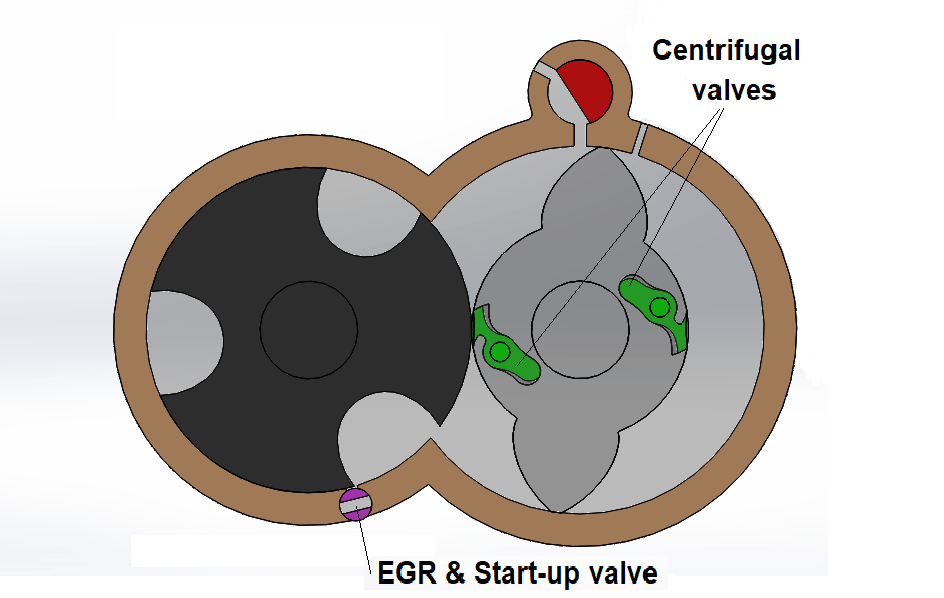
At rest and during the low speed rotation of the starter motor, the two lobe rotor valves close the fluid passage between the rotors, and the cavity exhaust valve is also closed. Thus the charge of compressed air that clears the chamber during normal operation, combines with the incoming fresh charge of air, to give the Eclipse Engine three times the regular combustion chamber volume for start-up. Once the engine fires and the RPM threshold is reached, the centrifugal valves automatically open, and the engine is running. This feature also means the starter motor size and weight requirements are greatly reduced, making the overall Eclipse design more viable as a transport engine.
The Twin Eclipse Engine builds on the Eclipse design by adding a second lobe rotor and components on the opposite side of the cavity rotor, creating a second combustion zone. This petrol engine delivers six combustion events of 60° each per cavity rotor revolution, producing torque continuously. This design is ideal for SACI, because each cavity has a combustion event every 180° of rotation, only minimal hot gases will need to be recycled within the cavity to achieve ignition. That will allow the Eclipse Engine to operate with lower compression rates, and leaner fuel mixture.
The Eclipse DT extends this concept by mounting two Twin Eclipse Engines back-to-back, with the synchronizing gears located between. With this breakthrough design the engine is on power stroke 200% of the time. It is possibly the most powerful and compact internal combustion engine for size and weight ever conceived.
 Intemesher Engines